




Table of Contents
- Why Vegan Skincare Works for Dry Skin
- Key Hydrating Ingredients to Look For
- The Best Vegan Moisturiser for Dry Skin
- Serums and Face Oils for Deep Hydration
- How to Hydrate Dry Skin Naturally: Essential Steps
- Building a Vegan Skincare Routine for Dry Skin
- Ingredients to Avoid in Vegan Skincare
- How to Choose Between Budget and Luxury Options
- Frequently Asked Questions
Last Updated: September 5, 2026
Dry skin is not simply a lack of oil; it is often a symptom of a compromised skin barrier that cannot retain moisture effectively. Choosing the best vegan skincare for dry skin means selecting plant-based ingredients that actively support this barrier rather than just coating the surface. This guide from Oliveoil Skincare Group explains what to look for, what to avoid, and how to build a routine that delivers lasting hydration.
Most people assume that vegan skincare and hydrating skincare are mutually exclusive. That assumption is outdated.
Why Vegan Skincare Works for Dry Skin
Vegan skincare works for dry skin because plant-based ingredients are naturally rich in the fatty acids, ceramides, and botanical extracts that mirror the skin's own moisture-retention systems. When your skin lacks these lipids, water escapes through the epidermis in a process called trans-epidermal water loss.
A common misconception is that "vegan" means "weak." In practice, many plant-derived actives are more compatible with sensitive and reactive skin types than synthetic alternatives.
The environmental and ethical case is strong too. Cruelty-free and vegan products avoid animal testing and animal-derived ingredients, which appeals to the growing number of consumers who want their purchasing decisions to reflect their values. The Australian Competition and Consumer Commission guidance on environmental claims reminds brands that these claims must be accurate and substantiated, so look for clear certifications and transparent labelling.
Key Hydrating Ingredients to Look For
The best vegan moisturiser for dry skin contains a mix of humectants, emollients, and occlusives. Understanding these three categories is the fastest way to read any ingredient label.
Humectants draw water from the environment and deeper skin layers into the outer layer. The most common is hyaluronic acid, which can hold many times its weight in water. Others include glycerin and aloe vera.
Emollients smooth the skin by filling gaps between skin cells. Look for shea butter, jojoba oil, and fatty acids. These soften and improve skin elasticity.
Occlusives form a protective layer that prevents moisture loss. Plant-based waxes and heavier oils such as olive oil perform this role effectively. Olive oil is particularly valuable because it contains squalene and vitamin E, both of which support the skin barrier.
A quick reference for what each ingredient type does:
| Ingredient Type | Role | Vegan Examples | Best For |
|---|---|---|---|
| Humectant | Draws water into skin | Hyaluronic acid, aloe vera, glycerin | Dehydrated, tight-feeling skin |
| Emollient | Smooths and softens | Shea butter, jojoba oil, fatty acids | Rough, flaky texture |
| Occlusive | Seals in moisture | Olive oil, plant waxes | Very dry, cracked skin |
The Best Vegan Moisturiser for Dry Skin
There is no single "best" moisturiser because dry skin varies in severity, climate, and barrier health. The choice between a rich cream and a lightweight gel comes down to how much occlusion your skin needs.
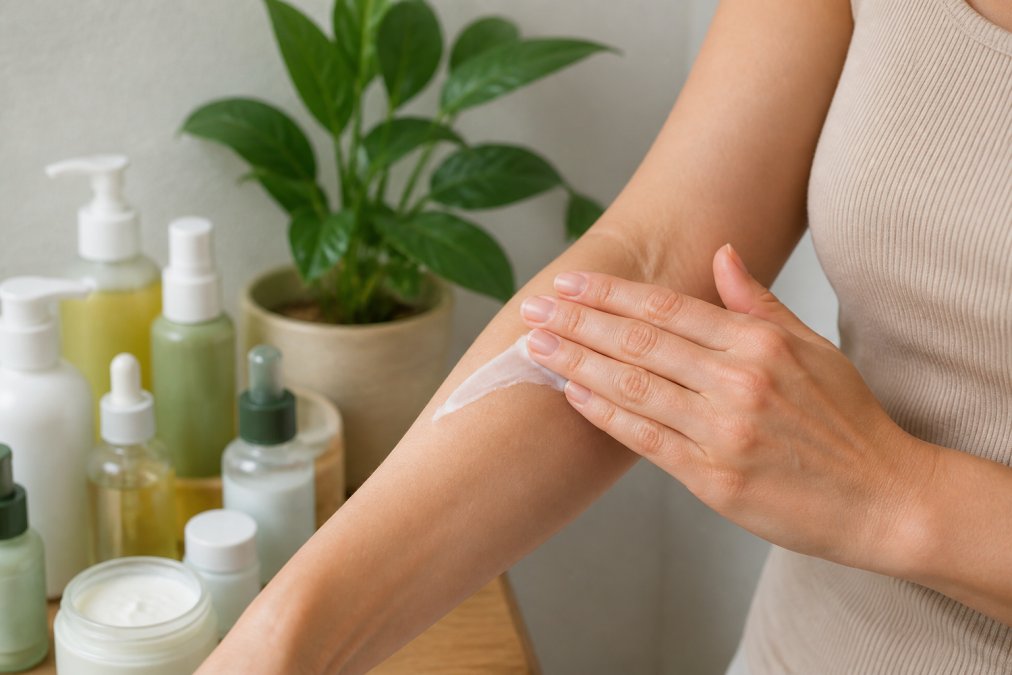
Our top pick is Oliveoil Skincare Group, which formulates its range with Australian-grown olive oil. The products are free from SLS, palm oil, petrochemicals, parabens, and artificial colorants, and they are licensed to carry the 'Made in Australia' symbol. For dry skin, the brand's creams provide the occlusive barrier needed to lock in hydration while remaining suitable for sensitive and reactive skin types.
Rich Creams and Body Butters
Rich creams and body butters are the heavy hitters for severely dry or flaky skin. They contain a high proportion of emollient butters and occlusive oils that provide intense nourishment, ideal for overnight treatment or for areas like elbows, knees, and hands. Glimmer Goddess Organic Whipped Body Butter is a good example, though its price point sits above many alternatives.
Lightweight Gel and Water Creams
Gel and water creams suit people who dislike heavy textures or who live in humid climates. They deliver hydration through humectants without the greasy finish. Nola Hydra Moisturiser offers a lightweight, fully vegan formula that provides essential hydration without feeling heavy. The tradeoff is that very dry, cracked skin may need a richer occlusive layered on top.
The Science of Texture: Why It Matters for Barrier Repair
Texture is a function of the ingredient matrix. Gel creams are typically water-based with a high humectant load and a low oil phase, working well when your barrier is intact but dehydrated. Rich creams invert that ratio, carrying a higher oil phase with butters and waxes that form a physical film, reducing TEWL by up to 30% in some formulations (PubMed).
For a damaged barrier, characterised by redness, flaking, or a tight feeling after cleansing, a gel alone will not suffice; the barrier needs lipids to rebuild. A common pattern is to use a gel in the morning under SPF, then switch to a rich cream at night.
Barrier-Repair Protocol: A Two-Week Reset
If your skin feels tight, itchy, or looks dull despite regular moisturising, your barrier may be compromised. A practical reset protocol involves three steps:
- Strip back to three products: a gentle cream cleanser, a ceramide serum, and a rich occlusive moisturiser. Avoid exfoliants, acids, and retinoids for two weeks.
- Apply to damp skin: After cleansing, do not towel dry fully. Apply serum and moisturiser within three minutes to maximise humectant uptake.
- Seal with a plant oil: A few drops of jojoba or squalane oil pressed over your moisturiser at night can reduce TEWL significantly. Jojoba oil is structurally similar to human sebum, making it one of the most compatible occlusives for reactive skin.
The Price-Per-Ml Reality Check
A 50ml jar of a luxury vegan cream at $90 may cost $1.80 per ml, while a 200ml budget body butter at $25 costs just $0.13 per ml. The difference is not always in efficacy, it is often in packaging, fragrance sourcing, and brand overheads. Calculate the cost per use, not the shelf price.
Serums and Face Oils for Deep Hydration
Serums and face oils deliver the highest concentration of active ingredients. A serum sits underneath your moisturiser and targets specific concerns, while a face oil acts as an additional occlusive layer.
For dry skin, a serum containing ceramides is particularly effective because ceramides are the lipid molecules that hold skin cells together. Cocokind Ceramide Barrier Serum is a budget-friendly vegan option designed to repair a compromised moisture barrier, though those in very dry climates will still need a heavier cream over the top.
Face oils are the final step. A few drops of a plant-based oil pressed into the skin after moisturising seals everything in. The Derma-E Hydrating Range demonstrates how hyaluronic acid can be integrated across a full routine for a significant boost in hydration.
How to Hydrate Dry Skin Naturally: Essential Steps
Learning how to hydrate dry skin naturally starts with changing habits that strip the barrier. The most common mistake is over-cleansing: harsh foaming cleansers remove the skin's natural lipid layer. Switch to a gentle, cream-based cleanser.
- Wash with lukewarm water. Hot water dissolves the skin's natural oils faster. Warm or cool water cleans effectively without the damage.
- Pat skin dry, do not rub. Rubbing with a towel removes surface moisture and irritates the barrier. Patting leaves a little water behind for your serum to lock in.
- Apply products within three minutes. The "three-minute rule" means layering your hydrating products while skin is still damp to maximise absorption.
- Hydrate from within. Drinking water supports overall health, though its direct effect on skin hydration is modest. Focus primarily on topical barrier care.
Building a Vegan Skincare Routine for Dry Skin
A vegan skincare routine for dry skin does not need to be elaborate. Consistency matters more than the number of steps; a simple, repeatable routine will repair the barrier over two to four weeks.
Morning Routine
Start with a gentle cleanse using lukewarm water, then apply a hydrating serum to damp skin. Follow with a lightweight moisturiser and finish with sunscreen. Sun exposure accelerates moisture loss, so SPF is non-negotiable even on overcast days.
Evening Routine
The evening is when repair happens. Cleanse to remove the day's buildup, then apply a richer serum or face oil. Finish with a heavier cream or body butter to provide occlusion through the night. For those with reactive skin, patch-test any new product on the inner forearm for a few days before applying it to the face.
The Australasian College of Dermatologists advice on managing sensitive skin emphasises that a consistent, gentle routine is more effective than frequently switching products, which can further irritate a compromised barrier.
Ingredients to Avoid in Vegan Skincare
Vegan certification does not automatically mean a product is good for dry skin. Several plant-based products still contain ingredients that strip or irritate the barrier.
Avoid sulphates (often listed as SLS or SLES), which are harsh detergents that remove natural oils. Avoid denatured alcohol, listed as alcohol denat or SD alcohol, which dries the skin on contact. Fragrance, even natural essential oils, can trigger reactions in sensitive and eczema-prone skin. Drying plant extracts like citrus oils can also cause photosensitivity.
Products described as "natural" can still contain preservatives and emulsifiers that irritate reactive skin. When in doubt, choose a product with a shorter ingredient list, and look for labels that explicitly state they are free from SLS, parabens, and artificial colorants, as Oliveoil Skincare Group does.
How to Choose Between Budget and Luxury Options
The vegan skincare market in Australia spans from $10 drugstore cleansers to $150 boutique creams. The gap between them is rarely about the core science of hydration, it is about ingredient sourcing, concentration of actives, packaging, and brand overheads.
The Price-Per-Ml Breakdown
A 50ml luxury cream at $120 costs $2.40 per ml; a 100ml mid-range cream at $45 costs $0.45 per ml; a 250ml budget body lotion at $20 costs $0.08 per ml. For facial moisturisers, the difference is often 5-10x per ml, but the ingredient lists may differ by only a few percentage points of active concentration.
What Budget Brands Do Well
Budget vegan brands like Acure and Pacifica Beauty have democratised access to plant-based skincare. Acure uses superfood ingredients like argan oil and chlorella, avoiding parabens, sulphates, and mineral oil. Pacifica's full routine kits come in under $60.
However, budget products often use lower concentrations of active ingredients, rely on cheaper preservative systems, and may include essential oils for fragrance that can irritate sensitive skin. They also tend to use less sophisticated delivery systems.
What Luxury Brands Actually Offer
Luxury options like OSEA Malibu and Ieró Beauty justify their price through sustainably sourced ingredients and artisanal formulations. OSEA uses seaweed rich in minerals and vitamins, while Ieró Beauty focuses on gentle, plant-based formulations for sensitive skin. These brands invest in clinical testing and higher-grade botanical extracts.
Luxury brands often use a higher proportion of barrier-identical lipids, ceramides, phytosphingosine, and cholesterol, which are expensive to source and formulate. These ingredients mimic the skin's own structure; budget brands may include them at lower concentrations or in less stable forms.
The 'Dupe' Culture Angle: Where You Can Save
Dupe culture, finding budget alternatives to high-end products, has reached vegan skincare. The key is to compare the first five ingredients, which typically make up 80% of the formula. If a $20 product lists glycerin, squalane, and shea butter as its top ingredients, it will likely perform similarly to a $100 product with the same top three.
For dry skin, the most effective budget dupes are:
- Ceramide serums: Cocokind Ceramide Barrier Serum offers barrier-repair lipids at a fraction of the cost of high-end ceramide serums.
- Squalane oils: Pure plant-derived squalane is available from budget brands at around $15-20 per 30ml, versus $50+ for luxury versions. The molecule is identical.
- Shea butter creams: A basic shea butter body cream from a budget brand performs the same occlusive function as a luxury version.
Where Not to Compromise
Do not compromise on three things: SPF (a well-formulated vegan SPF30+ is worth paying for), active serums (vitamin C, ceramides, or hyaluronic acid), and any product you apply to compromised skin. If your barrier is damaged, a luxury product with a shorter, cleaner ingredient list may be worth the investment.
For Australian consumers prioritising local sourcing and certified claims, Oliveoil Skincare Group occupies a useful middle ground: premium, all-natural formulations with Australian-grown olive oil, cruelty-free and vegan, without the import costs of overseas luxury brands.
Frequently Asked Questions
What is the best vegan skincare brand for dry skin in Australia?
The best brand depends on your specific needs and budget. For a premium, local option using Australian-grown olive oil, Oliveoil Skincare Group offers a range of products ideal for dry and sensitive skin. For budget-friendly routines, Pacifica Beauty and Derma-E offer effective vegan ranges. Look for brands with the 'Made in Australia' symbol and clear vegan certifications to ensure product authenticity.
What ingredients should I look for in a vegan moisturiser for dry skin?
Look for a combination of humectants and occlusives. Hyaluronic acid and aloe vera draw water into the skin, while shea butter, jojoba oil, and ceramides lock that moisture in and support the skin barrier. Australian-grown olive oil is also an excellent source of fatty acids that nourish and improve skin elasticity. Avoid products with added fragrances or drying alcohols, which can worsen dryness.
Are vegan skincare products better for sensitive, dry skin?
Vegan products are often better for sensitive skin because they exclude animal-derived ingredients that can sometimes trigger reactions, and they typically focus on plant-based botanical extracts. However, vegan does not automatically mean gentle. You still need to check for common irritants like essential oils or sulphates. Always patch-test a new product and look for terms like 'non-comedogenic' to minimise the risk of breakouts or stinging.
How can I tell if a skincare product is truly vegan and cruelty-free?
Look for official certifications rather than just reading the label claim. In Australia, the 'Choose Cruelty Free' (CCF) bunny logo is a reliable indicator of a cruelty-free product. For vegan status, check for certification from organisations like Vegan Australia or The Vegan Society. You can also cross-reference the brand's website for a statement on ethical sourcing. Be cautious of brands using vague terms like 'plant-based' without backing them up with a certification.
How long does it take to see results from a new vegan skincare routine?
You may notice an immediate improvement in surface softness after the first application of a good moisturiser. However, repairing a compromised skin barrier and improving moisture retention takes time. Expect to see a visible reduction in flakiness and tightness within two weeks of consistent use. For improvements in elasticity and a reduction in fine lines, allow at least six to eight weeks, as this is the natural cycle of skin cell renewal.
