




Table of Contents
- Why 2026 Is the Year of Longevity Beauty, Not Anti-Ageing
- The Core Steps of a Natural Anti-Ageing Skincare Routine
- The Best Natural Anti-Ageing Ingredients 2026 Has to Offer
- How to Layer Natural Skincare Products Without Irritation
- Building an Anti-Ageing Skincare Routine for Your 40s and Beyond
- The Benefits of Olive Oil for Face and Skin Barrier Health
- Sustainability, Ethical Sourcing and What to Ignore in 2026
- Conclusion: Your Next Step
- Frequently Asked Questions
Last Updated: September 11, 2026
Why 2026 Is the Year of Longevity Beauty, Not Anti-Ageing
The global natural beauty market reached USD 31.4 billion in 2024 and is projected to hit USD 52.2 billion, according to NATRUE's 2026 natural beauty trends report. That growth reflects a fundamental shift in how people approach ageing skin. The conversation has moved from fighting wrinkles to supporting long-term skin health.
This guide from Oliveoil Skincare Group breaks down what a natural anti aging skincare routine 2026 actually looks like, from morning protection to evening repair. Below, we'll show you exactly which ingredients matter, how to layer them without triggering irritation, and why olive oil deserves a permanent spot on your shelf.
The stakes are higher than most people realise. The "skinification" market is predicted to grow 25.0% year on year (Forbes longevity beauty report), and professional regenerative treatments like Rejuran salmon DNA jumped 121% in demand (VIP Medi Spa regenerative skincare trends). But here's what most guides get wrong: you don't need a clinic visit or a 12-step regimen to see results.
The Core Steps of a Natural Anti-Ageing Skincare Routine
A natural anti-ageing skincare routine is a consistent daily practice of cleansing, treating, moisturising and protecting skin with ingredients that support its natural repair processes. In 2026, dermatologists advocate for simpler, simplified regimens involving daily SPF and proven actives (Women's Health Magazine skincare guidance).
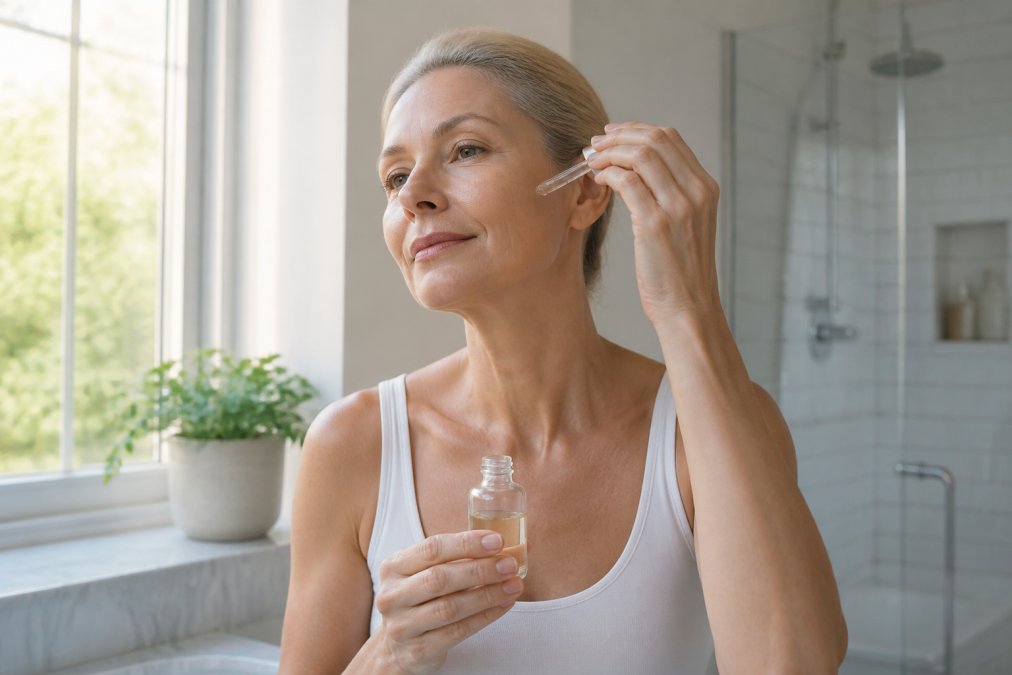
Morning: Protect and Prevent
Start with a gentle cleanser to remove overnight buildup without stripping your skin barrier. Follow with an antioxidant serum, vitamin C being the most researched option for defending against free radical damage and photoaging. Apply a moisturiser while skin is still slightly damp, then finish with SPF 30+ every single morning.
The sunscreen step is non-negotiable. UV exposure accounts for the majority of visible ageing, and no serum can outpace daily sun damage.
Evening: Repair and Restore
Evening is when your skin does its repair work. Remove the day's buildup with a cleansing oil, which dissolves sunscreen and grime without disrupting the microbiome. Apply your treatment serum, whether that's a retinoid, bakuchiol or peptide blend. Seal everything in with a richer night cream.
The Best Natural Anti-Ageing Ingredients 2026 Has to Offer
The best natural anti-ageing ingredients 2026 has to offer combine botanical actives with clinically studied compounds. Key ingredients trending this year include peptides, ceramides, niacinamide, bakuchiol and antioxidant complexes (Veriphy Skincare ingredient analysis). But the more useful question is not which ingredients are trending, it is which ones do what, at what strength, and how they behave when you mix a botanical option with a clinical-grade one.
Here is how the main options compare:
| Ingredient | Primary Benefit | Best For | Notes |
|---|---|---|---|
| Retinoid | Cellular turnover, fine lines | Experienced users | Start 2x weekly |
| Bakuchiol | Retinol-like effects | Sensitive skin | Gentler, plant-derived |
| Vitamin C | Antioxidant, brightening | Morning use | Pairs with SPF |
| Peptides | Collagen production | All skin types | Supports elasticity |
| Niacinamide | Barrier support, redness | Reactive skin | Well tolerated |
| Ceramides | Hydration, barrier repair | Dry, mature skin | Critical after 40 |
What each ingredient actually does
Retinoids speed up cell turnover and stimulate collagen, which is why they remain the most evidence-backed anti-ageing active. The trade-off is tolerability: dryness, flaking and redness are common in the first few weeks. Most practitioners recommend starting at two nights per week and building up slowly.
Bakuchiol is a plant-derived compound that behaves like a gentler retinol. It does not cause the same photosensitivity or peeling for most people, which makes it the usual entry point for sensitive or reactive skin. It is not a like-for-like swap in strength, think of it as a softer, more tolerable option rather than a stronger one.
Vitamin C is an antioxidant first and a brightener second. Its job in the morning is to neutralise free radicals generated by UV and pollution before they damage collagen. It works best layered under sunscreen, not instead of it.
Peptides are short chains of amino acids that signal the skin to support its own collagen and elastin. They are well tolerated by nearly everyone and are a sensible option for people who cannot use retinoids.
Niacinamide supports the barrier, helps calm redness and can reduce the look of enlarged pores. It is one of the most forgiving actives and pairs well with almost everything.
Ceramides are lipids that make up part of the skin barrier. After 40, the barrier becomes less efficient at holding water, so ceramide-rich moisturisers become more important than any single serum.
Mixing natural actives with clinical-grade ingredients
This is where most guides stop, and where most confusion starts. The good news is that natural and clinical actives are not rivals, they are usually complementary. The rules that matter:
- Bakuchiol plus vitamin C is generally fine. Use vitamin C in the morning and bakuchiol at night to keep the routine simple.
- Bakuchiol plus a retinoid is not recommended in the same application. Pick one for the evening and rotate if you want to use both.
- Vitamin C plus a retinoid should be split across morning and evening. Combining them in one layer increases the chance of irritation without adding benefit.
- Niacinamide plus vitamin C is a common worry, but modern formulations are stable together. If your skin stings, separate them rather than abandoning either.
- Peptides plus acids can reduce peptide effectiveness. If you use an exfoliating acid, apply it on a different evening.
A simple rule: one treatment active per session. Everything else in the routine, cleanser, moisturiser, SPF, is there to support it.
How to Layer Natural Skincare Products Without Irritation
Layering natural skincare products correctly means applying from thinnest to thickest consistency, with water-based formulas first and oil-based products last. This allows each layer to absorb before the next one goes on.
The order:
- Cleanser
- Toner or essence
- Water-based serums
- Treatment serums
- Moisturiser
- Facial oil or SPF
Wait 30 to 60 seconds between each layer. Rushing causes pilling and reduces absorption. If you're introducing a new active, add it one at a time and give your skin two weeks to adjust before adding another.
A common mistake is mixing vitamin C with retinoids in the same application. Use vitamin C in the morning and retinoids at night to avoid irritation.
Building an Anti-Ageing Skincare Routine for Your 40s and Beyond
An anti-ageing skincare routine for your 40s and beyond should focus on collagen support, hydration and barrier repair, since natural collagen production drops significantly after this decade. The products that worked in your 30s often aren't enough.
What changes: your skin produces less oil, loses elasticity faster, and takes longer to recover from irritation. That means richer moisturisers, gentler exfoliation, and more consistent SPF use.
What changes by decade
In your 30s, the priority is prevention. Cell turnover is still relatively efficient, so a simple routine, gentle cleanser, antioxidant serum, moisturiser, SPF, plus a retinoid two or three nights a week is usually enough. This is the decade to build the habit, not to add more products.
In your 40s, collagen and elastin decline becomes visible. Fine lines around the eyes and mouth deepen, and skin can look duller because turnover slows. This is when peptides, ceramides and a consistent retinoid or bakuchiol step start to earn their place. Hydration becomes a treatment, not just a comfort.
In your 50s and beyond, the barrier is thinner and drier, and irritation recovers more slowly. Richer creams, occlusive ingredients and gentle cleansing matter more than adding new actives. Many people find they need to reduce exfoliation frequency rather than increase it.
A practical 40-plus routine
- Morning: gentle cleanser, vitamin C or antioxidant serum, moisturiser, SPF 30+.
- Evening: cleansing oil to remove sunscreen, gentle second cleanse if needed, treatment serum (retinoid or bakuchiol), richer night cream.
- Weekly: one gentle chemical exfoliation session, not a scrub.
Oliveoil Skincare Group's Zetox Night Restorative Cream is formulated with zeolite, natural extracts and precious oils to hydrate and condition skin overnight while helping reduce the appearance of fine lines. For daytime, the Zetox Protective Daily Moisturiser combines calendula flower, green tea leaf and olive oil to hydrate and protect against free radicals.


For a serum step, the Juniper Orange Facial Serum offers a lightweight blend of vitamins and antioxidants that smooths skin and reduces the look of fine lines.

When your skin reacts: purging versus irritation
Most guides list products and stop there. The part that actually decides whether a routine works is what you do when your skin pushes back.
Purging happens when an active speeds up cell turnover and brings existing congestion to the surface. It looks like small bumps in areas you normally break out, and it settles within a few weeks. It is most common with retinoids and exfoliating acids.
Irritation is different. It looks like redness, stinging, flaking or a rash in areas you do not normally break out, and it does not improve on its own. It is a sign the product is too strong or too frequent for your skin right now.
What to do:
- Pause the active for three to five days and go back to cleanser, moisturiser and SPF only.
- Reintroduce it at half the frequency, for example, once a week instead of twice.
- Apply it over moisturiser rather than under it to buffer the effect.
- If irritation returns at the lowest frequency, switch to a gentler alternative such as bakuchiol.
The Benefits of Olive Oil for Face and Skin Barrier Health
The benefits of olive oil for face and skin barrier health come down to its fatty acid profile and antioxidant content. Olive oil contains squalene and oleic acid, both of which help maintain skin flexibility and suppleness while supporting the barrier that keeps moisture in and irritants out.
Research shows that effective anti-ageing routines in 2026 must prioritise skin barrier integrity and microbiome balance (Image Skincare 2026 anti-aging report). Olive oil supports both. Its anti-inflammatory properties make it particularly useful for mature skin, dry skin, and skin prone to redness.
It also plays well with other ingredients. Olive oil-based products can be layered under or over water-based serums without causing the pilling that heavier oils sometimes trigger.
For cleansing, the Facial Cleansing Oil, Naturally Nourished blends olive, sunflower and castor oils with bergamot and orange essential oils to remove makeup and sunscreen gently. Once or twice weekly, the Zetox Illuminating Face Clay Mask uses zeolite, kaolin and olive oil to detoxify and brighten without stripping.
Sustainability, Ethical Sourcing and What to Ignore in 2026
Sustainability in skincare is no longer a nice-to-have. Consumers increasingly want to know where ingredients come from, how they're sourced, and whether the brand's claims hold up. Look for certifications rather than marketing language.
Oliveoil Skincare Group is licensed to carry the 'Made in Australia' symbol and formulates with Australian-grown olive oil. Its products are cruelty-free, vegan, and free from SLS, palm oil, petrochemicals, parabens and artificial colorants. That transparency matters more than any trending ingredient.
What to ignore: physical exfoliation scrubs. Chemical exfoliation using topical products is preferred for ageing skin to minimise damage (Harvard Health Publishing on exfoliation). Walnut shells and sugar grains create microtears that worsen inflammation over time.
The shift from 'anti-aging' to 'longevity beauty' reflects a broader change. The goal isn't reversing age. It's maintaining skin that functions well for decades.
Conclusion: Your Next Step
Building a routine that actually works takes consistency, not complexity. The challenge is finding products gentle enough for daily use that still deliver real results for mature skin.
Oliveoil Skincare Group makes that simpler. Every product is formulated with Australian-grown olive oil, hypo-allergenic for most skin types, and free from the harsh additives that trigger reactions. The range covers your full routine, from the Naturally Nourished Cleansing Oil to the Zetox Night Restorative Cream, so you're not piecing together products from five different brands.
Get started with Oliveoil Skincare Group and build a routine your skin can actually maintain.
Frequently Asked Questions
What is the most natural anti-ageing skincare routine?
A natural anti-ageing skincare routine centres on four steps: a gentle cleanser, an antioxidant-rich serum, a moisturiser that supports the skin barrier, and daily SPF 30+. In 2026, dermatologists recommend focusing on barrier integrity and microbiome balance rather than aggressive interventions. Ingredients like olive oil, peptides, bakuchiol and vitamin C deliver results without synthetic fillers, making the routine suitable for most skin types including sensitive or reactive skin.
How do I layer natural skincare products correctly?
Apply products from thinnest to thickest consistency. Start with a cleansing oil, follow with a water-based serum, then a facial oil or moisturiser, and finish with SPF in the morning. Wait 30 to 60 seconds between each layer to let products absorb. If you use a retinoid or exfoliant, apply it after cleansing and before moisturiser. This layering method prevents pilling and ensures each product penetrates effectively.
Are natural skincare products as effective as clinical alternatives?
Natural actives like bakuchiol, vitamin C from botanical sources and olive oil polyphenols have demonstrated measurable anti-ageing benefits. Bakuchiol, for example, shows retinol-like effects on fine lines with less irritation. However, some clinical-grade ingredients such as prescription retinoids work faster for deep wrinkles. The biggest opportunity in 2026 is combining both: botanical actives for daily barrier support and targeted clinical ingredients where needed.
How long before I see results from a natural anti-ageing routine?
Most people notice improved hydration and skin texture within two to four weeks. Fine lines and hyperpigmentation typically take eight to twelve weeks of consistent use to visibly reduce, because cellular turnover slows with age. Consistency matters more than product count; a simple routine used daily outperforms a complex one used sporadically.
What are the key skincare trends for 2026?
The dominant trend is longevity beauty, which shifts focus from wrinkle reduction to long-term skin health. Regenerative treatments grew significantly, with Rejuran salmon DNA treatments up 121% and exosome therapies up 150%. The natural beauty market reached USD 31.4 billion in 2024 and is projected to hit USD 52.2 billion. Skinification grew 25% year on year. Streamlined routines, microbiome-focused formulations and sustainability credentials are now mainstream expectations, not niche preferences.
Can I use olive oil on my face every day?
Yes, olive oil is suitable for daily facial use when formulated into skincare products. It contains squalene and polyphenols that moisturise and support the skin barrier. Olive oil is rich in antioxidants that help protect against free radical damage, a key driver of photoaging. For best results, use it as part of a moisturiser or serum rather than straight from the kitchen bottle, since cosmetic formulations are tested for absorption and non-comedogenic performance.
