




Table of Contents
- Is Olive Oil Safe for Eczema-Prone Skin?
- What the Research Says About Oleic Acid and the Skin Barrier
- How Natural Olive Oil for Eczema Relief Affects Your Skin Barrier
- Benefits of Olive Oil for Dry Skin (and Where It Falls Short)
- How to Patch Test Olive Oil Products Before Use
- Culinary vs Cosmetic-Grade Olive Oil: Does It Matter?
- Where to Buy Natural Olive Oil Body Lotion for Eczema Care
- Frequently Asked Questions
Last Updated: September 14, 2026
Is Olive Oil Safe for Eczema-Prone Skin?
For most people with eczema, applying natural olive oil for eczema relief is not recommended, and the evidence against it is stronger than the folk wisdom supporting it. Olive oil is a kitchen staple with genuine nutritional value, but skin barrier science tells a different story when it meets atopic dermatitis.
At Oliveoil Skincare Group, we formulate with Australian-grown olive oil, so we have a commercial interest in this debate. We also have an interest in getting it right, which is why we follow the dermatology literature closely. The research is uncomfortable reading for anyone who has been pouring pantry oil onto a flare-up.
The short answer: olive oil is safe to eat and risky to apply to compromised skin. Here's the science behind that split.
What the Research Says About Oleic Acid and the Skin Barrier
Oleic acid is the monounsaturated fatty acid that makes up roughly 55-83% of olive oil, and it is the compound most responsible for the barrier disruption researchers have observed. To understand why, you need to know what the skin barrier is actually made of.
The stratum corneum, the outermost layer, is often described as a brick-and-mortar structure. The "bricks" are corneocytes (flattened, protein-rich skin cells). The "mortar" is a lipid matrix of ceramides, cholesterol and free fatty acids, arranged in stacked, ordered layers. That ordered arrangement is what keeps water in and irritants out.
How Oleic Acid Disrupts the Lipid Matrix
Oleic acid is a monounsaturated fatty acid with a single kink in its carbon chain. Linoleic acid, the fatty acid eczema-prone skin tends to be short on, is polyunsaturated and integrates more cleanly into the lipid mortar. Oleic acid, by contrast, inserts itself into the ordered lipid layers and disrupts their packing. The result is a looser, more permeable barrier.
That mechanism explains the clinical findings. A University of Manchester study on olive oil and skin barrier damage found that topical olive oil damaged the skin barrier in adult volunteers, and a follow-up comparison with sunflower oil showed olive oil increased redness while decreasing skin integrity. The study design matters here: these were controlled applications to intact forearm skin in healthy adults, not eczema patients, which means the effect on already-compromised skin is likely to be at least as pronounced.
Why This Matters More for Eczema-Prone Skin
In atopic dermatitis, the lipid mortar is already defective. Filaggrin mutations, present in a significant proportion of people with eczema, reduce the skin's natural moisturising factors and leave the barrier structurally weaker from birth. Adding oleic acid to that picture is like loosening mortar in a wall that is already cracking.
A common pattern practitioners describe is a short-lived improvement followed by a flare: the oil feels soothing for a day or two because it is occlusive, then redness and itching increase as barrier function drops. That delayed reaction is one reason olive oil gets recommended so often by well-meaning sources, the immediate experience is pleasant, and the harm shows up later.
The takeaway from the research is not that olive oil is toxic. It is that oleic acid is the wrong fatty acid for a barrier that is already struggling, and the evidence for that is stronger than the folk wisdom supporting raw oil application.
How Natural Olive Oil for Eczema Relief Affects Your Skin Barrier
Natural olive oil for eczema relief works against the skin in two measurable ways: it disrupts the lipid barrier and increases water loss through the skin. The lipid barrier is the outermost layer of skin, a structured matrix of ceramides, cholesterol and fatty acids that keeps irritants out and moisture in.
Transepidermal Water Loss and Lipid Barrier Damage
Transepidermal water loss (TEWL) is the measurement of water evaporating through the skin, and it is the standard clinical marker for barrier function. When the lipid barrier is compromised, TEWL rises, skin dries further, and the itch-scratch cycle accelerates. In eczema-prone skin, the barrier is already impaired, so anything that increases TEWL makes a flare-up worse.
The Manchester research comparing olive and sunflower oil demonstrated exactly this pattern: more redness, less barrier integrity.
Benefits of Olive Oil for Dry Skin (and Where It Falls Short)
Olive oil does have legitimate benefits for intact, healthy skin. It contains squalene, vitamin E and polyphenols with antioxidant properties, and it works as an occlusive agent that slows moisture loss on undamaged skin.
Where it falls short is on compromised skin. The distinction matters:
| Skin Condition | Olive Oil Effect | Better Choice |
|---|---|---|
| Healthy, intact skin | Occlusive, antioxidant support | Fine as a body oil |
| Mild dryness | Temporary softness | Emollient with ceramides |
| Active eczema flare | Barrier disruption, redness | Dermatologist-approved emollient |
| Seborrheic dermatitis | May feed malassezia yeast | Avoid entirely |
That last row deserves attention. Malassezia is the yeast implicated in seborrheic dermatitis, and oleic acid is a known trigger for it. If your "eczema" is actually seborrheic dermatitis, olive oil can make it visibly worse.
How to Patch Test Olive Oil Products Before Use
Patch testing is the only reliable way to know how your skin responds to any new product, and it takes 48 hours. Do not skip it because a product is labelled natural; natural ingredients cause contact dermatitis just as readily as synthetic ones. This is the gap most guides miss, they give a generic cosmetic patch-test protocol and ignore the fact that eczema-prone skin reacts differently.
Why Standard Patch Testing Falls Short for Eczema
A standard patch test catches immediate irritant reactions. It does not reliably catch two things that matter for eczema-prone skin:
- Delayed allergic contact dermatitis, which can take 72-96 hours to appear rather than 48.
- Cumulative irritation, where a product is fine once but problematic with repeated use on a compromised barrier.
That is why the protocol below extends the observation window and adds a repeat-application step. It is not a substitute for medical patch testing (epicutaneous testing) performed by a dermatologist or immunologist, which uses standardised allergens under occlusion. If you have had severe or unexplained reactions to skincare, ask for a referral.
A Step-by-Step Protocol for Reactive Skin
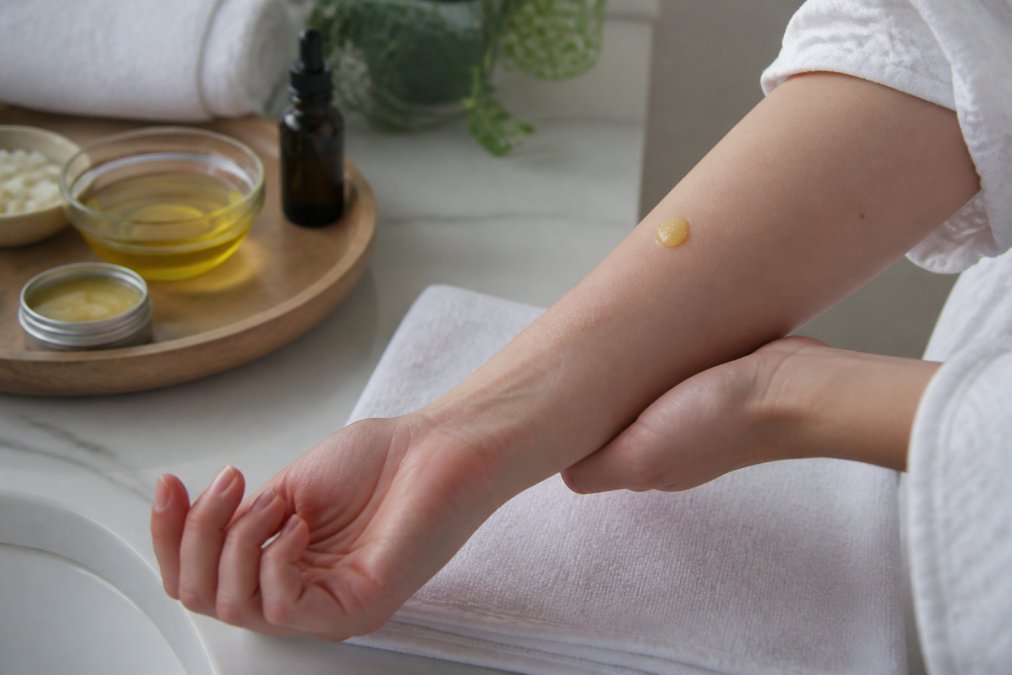
- Choose the right site. The inner forearm is the standard site because its thickness is closer to body skin than the face or neck. Avoid behind the ear, it is thinner and more reactive, so it produces false positives.
- Clean and dry. Wash with a fragrance-free cleanser, rinse, and let the area air-dry completely. Residual moisture can dilute the product and skew the result.
- Apply a 2cm square. Use a small, consistent amount, roughly the size of a five-cent coin. Do not rub it in aggressively; spread it thinly.
- Leave it uncovered for 48 hours. Avoid washing the area. If you must shower, cover the patch with a waterproof dressing.
- Check at 24, 48 and 72 hours. Look for redness, itching, stinging, swelling or small bumps. Photograph the site at each check so you have an objective record.
- If you react, stop. Wash the area with lukewarm water and a gentle cleanser. Do not apply another product on top to "calm" it, that confounds the result.
- If you do not react, repeat once. Apply the same amount to the same site daily for three more days. This catches cumulative irritation that a single 48-hour test misses.
- Then test on a small area of affected skin. Only after passing the repeat test should you apply to a small patch of eczema-prone skin, and only when that skin is not actively flaring.
What a Patch Test Cannot Tell You
A patch test will not predict a flare three weeks later, and it will not tell you whether a product will disrupt your barrier over time, only whether your skin reacts to it acutely. For olive oil specifically, the barrier-disruption effect is not an allergic reaction, so a negative patch test does not mean the oil is safe for long-term use on eczema.
If you have a known allergy to a specific oil or preservative, tell your dermatologist before patch testing at home. They can arrange standardised testing that is far more reliable than anything you can do in a bathroom.
Culinary vs Cosmetic-Grade Olive Oil: Does It Matter?
Cosmetic-grade olive oil and culinary olive oil are not interchangeable, and the difference is not marketing. Cosmetic-grade oil is processed to remove free fatty acids and impurities that irritate skin, and it is tested for stability and purity. Culinary oil is optimised for flavour and shelf life in food, not for topical tolerance.
Here is where most guides get it wrong: they treat "olive oil" as one ingredient. It is not. A refined cosmetic-grade olive oil in a properly formulated emollient behaves very differently from cold-pressed extra virgin oil poured from a bottle.
The Role of pH Balance in Topical Oils
pH balance matters because healthy skin sits at a mildly acidic pH of around 4.5 to 5.5, and that acidity supports the skin microbiome and barrier enzymes. Pure oils have no meaningful pH because they contain no water, but once an oil is emulsified into a lotion or cream, the formulation's pH becomes critical. A poorly buffered product can push skin pH alkaline and weaken the barrier further.
This is also where oil-in-water versus water-in-oil emulsions matter. Oil-in-water emulsions feel lighter and absorb faster, which suits daytime use. Water-in-oil emulsions are heavier and more occlusive, which suits overnight repair. Neither is universally better; the right choice depends on your skin and the severity of your flare.
Where to Buy Natural Olive Oil Body Lotion for Eczema Care
If you want to buy natural olive oil body lotion, look for products where olive oil is formulated into a balanced emollient rather than sold as a standalone oil. That is the whole point of proper formulation: the olive oil's moisturising and antioxidant properties are preserved, while the barrier-disrupting effects are managed.
Cleveland Clinic guidance on olive oil for skin is blunt on this point. Dermatologist Dr. Kabbur put it plainly:
"Keep olive oil in your diet and off your skin."
That is not a rejection of olive oil skincare. It is a rejection of applying raw oil to damaged skin. Formulated products that pair olive oil with barrier-supporting ingredients occupy a different category.
Managing eczema is a long-term project, and the products you use daily matter more than any single remedy. Oliveoil Skincare Group formulates with Australian-grown olive oil in products designed for sensitive, reactive skin, including the Soothing Balm Pure Original 60g, an unscented all-purpose balm free from SLS, palm oil, petrochemicals and artificial colourants. The range is cruelty-free, vegan, hypo-allergenic and licensed to carry the 'Made in Australia' symbol. Get started with Oliveoil Skincare Group and give your skin a routine built for resilience.

Frequently Asked Questions
Can olive oil be used to treat contact dermatitis?
Olive oil is not recommended for treating contact dermatitis. Research from the University of Manchester found that topical olive oil damages the skin barrier, increasing redness and reducing skin integrity. Since contact dermatitis already involves a compromised barrier, applying olive oil can worsen irritation. A 2017 comparison of olive oil and sunflower oil showed olive oil increased redness while sunflower oil preserved barrier function. For contact dermatitis, choose emollients containing ceramides or sunflower seed oil instead, and patch test any new product on a small area first.
Is olive oil soap good for eczema?
Traditional olive oil soap can strip the skin because of its high pH, which disrupts the acid mantle eczema-prone skin depends on. However, some modern formulations combine olive oil with gentle ingredients. For example, the Zetox Olive Oil Soap ($19.99) pairs olive oil with zeolite, a volcanic mineral that helps remove pollutants without harsh surfactants. If you have eczema, look for fragrance-free, SLS-free soaps and follow with a moisturiser within three minutes of washing to lock in hydration and reduce transepidermal water loss.
How does olive oil support the skin barrier for those with eczema?
The evidence suggests it often does the opposite. Olive oil is high in oleic acid, which can disrupt the lipid barrier and increase transepidermal water loss. Dermatologists like Dr. Kabbur advise keeping olive oil in your diet and off your skin. If you want barrier support, look for products with ceramides, linoleic acid, or squalene, and always patch test before applying to eczema-prone areas.
What is the best oil to put on sensitive skin?
Sunflower seed oil is one of the best options for sensitive, eczema-prone skin. University of Manchester researchers found it preserves skin barrier integrity, unlike olive oil which increased redness. Other good choices include oils high in linoleic acid, such as safflower oil, and emollients containing ceramides or squalene. Avoid oils high in oleic acid, including olive oil, especially during flare-ups. Whatever you choose, apply to damp skin after bathing to improve absorption and reduce water loss, and test on a small patch for 48 hours first.
