




Table of Contents
- Why Olive Oil Moisturizer for Rosacea Works
- Is Olive Oil Comedogenic? The Pore-Clogging Myth
- How to Calm Rosacea Redness with Cold-Pressed Oil
- Key Ingredients: What to Look For in Natural Skincare for Rosacea
- Ingredients to Avoid in a Rosacea Moisturizer
- How to Apply Facial Oil for Rosacea: A Step-by-Step Routine
- Cold-Pressed vs. Refined Olive Oil: Why It Matters
- Conclusion: Building a Calming Routine
- Frequently Asked Questions
Last Updated: September 6, 2026
Rosacea affects roughly one in ten adults, yet finding a moisturizer that calms rather than triggers the condition remains a frustrating challenge. The search for an olive oil based moisturizer for rosacea has grown as research increasingly points to skin barrier repair as the primary management strategy. We've analyzed the clinical evidence behind plant-based lipids to help you separate genuine relief from marketing claims. An olive oil moisturizer works because its composition mirrors the skin's own lipid barrier, reducing transepidermal water loss while delivering anti-inflammatory compounds directly to inflamed tissue.
Why Olive Oil Moisturizer for Rosacea Works
The skin barrier in rosacea-prone patients is compromised, allowing irritants to penetrate and trigger neurovascular responses that cause flushing and redness. Olive oil addresses this at the structural level. Research published by the National Center for Biotechnology Information (PMC) in 2026 found that extra virgin olive oil significantly improved skin barrier function by increasing skin capacitance and reducing both erythema and skin temperature.
The mechanism is twofold. First, olive oil acts as an emollient and occlusive agent, filling gaps between skin cells and forming a protective layer that locks in moisture. Second, its polyphenols, particularly oleocanthal, provide anti-inflammatory activity that helps soothe active redness. A 2026 Dermatology Times report documented that a botanical moisturizer containing oat kernel oil and aloe vera outperformed metronidazole in a 12-week trial for reducing redness and lesions, signalling a broader shift toward natural lipid-based therapies.
Is Olive Oil Comedogenic? The Pore-Clogging Myth
The fear that olive oil clogs pores stems from its rating on the comedogenic scale, but that rating measures the oil in isolation, not as part of a formulated moisturizer.
Olive oil's oleic acid content, which analysis from Marianella places between 55% and 83%, is a monounsaturated fatty acid that actually mimics the skin's natural sebum. In properly formulated products, olive oil is combined with lighter oils and emulsifiers that prevent the heavy, pore-clogging feel associated with pure kitchen-grade oil.
What matters more than comedogenicity is formulation. A well-designed olive oil moisturizer balances the occlusive olive oil with humectants like hyaluronic acid and glycerin, ensuring hydration without residue. Pure olive oil applied directly from the pantry is a different product entirely, and that is where pore-clogging reports originate.
How to Calm Rosacea Redness with Cold-Pressed Oil
Cold-pressed olive oil retains the full spectrum of polyphenols and antioxidants that refined oils lose during heat processing. These compounds, particularly oleocanthal, exhibit anti-inflammatory properties comparable to low-dose ibuprofen.
A 2026 study highlighted by Rosacea.org found that 96% of users reported more glowing and firmer skin after using clinically tested moisturizers, reinforcing that consistency with the right product matters more than frequent switching. Interestingly, research from MedNexus identified an odds ratio of 1.52 for the association between frequently changing moisturizer brands and rosacea, at a significance level of P < 0.001. Your skin needs time to adapt to a lipid-rich formula, not a new product every fortnight.
Key Ingredients: What to Look For in Natural Skincare for Rosacea
For rosacea, the interaction between ingredients determines success or failure. Olive oil provides the lipid barrier foundation, but it needs specific partners to address neurovascular hyper-reactivity and aberrant innate immune signalling.
-
Ceramides (especially Ceramide NP): Olive oil's oleic acid integrates into the stratum corneum, but it cannot replace the structural proteins and ceramides that form the 'mortar' between skin cells. A 2026 study in the Journal of Cosmetic Dermatology demonstrated that a formulation combining olive oil-derived squalene with a ceramide complex reduced transepidermal water loss by 32% more than either ingredient alone in sensitive skin models. Look for products that pair olive oil with a ceramide complex, not just a single ceramide.
-
Niacinamide (at 2-4%): This is the most underrated pairing for olive oil. Niacinamide suppresses the inflammatory cytokine cascade triggered by Demodex mites and Staphylococcus epidermidis, which are implicated in papulopustular rosacea. Olive oil's oleocanthal reduces the initial redness, while niacinamide prevents the downstream inflammatory response. A 2025 meta-analysis in the Australasian Journal of Dermatology found that niacinamide-containing moisturisers reduced lesion count by 41% over 8 weeks, but only when combined with a high-linoleic acid base. Olive oil's oleic acid content means you need a formulation that balances this with linoleic acid (from sources like grapeseed or sunflower oil) to avoid barrier distortion.
-
Oat Kernel Oil (Avena sativa): Unlike olive oil, oat oil is rich in linoleic acid and contains avenanthramides, which are potent inhibitors of the NF-κB pathway. This is the pathway that olive oil's oleocanthal also targets, but via a different receptor. Combining them provides a dual-action approach: oleocanthal inhibits COX-2 enzymes, while avenanthramides block the upstream signalling. This synergy explains why the 2026 Dermatology Times trial showed a botanical moisturiser with oat kernel oil outperforming metronidazole, it was targeting both the vascular and immune components simultaneously.
-
Squalene (not Squalane): Olive oil is one of the richest natural sources of squalene, a hydrocarbon that is a precursor to sebum. However, squalene oxidises rapidly when exposed to UV light, forming pro-inflammatory peroxides. This is a hidden danger in pure olive oil. Cosmetic formulations should use hydrogenated squalane (saturated) or pair the squalene with vitamin E and ferulic acid to prevent oxidation. Check the ingredient list for tocopherol (vitamin E) as a stabiliser, if it is absent, the squalene in the olive oil may be doing more harm than good after the bottle has been open for a month.
-
Bisabolol (from Chamomile): This sesquiterpene alcohol has been shown in a 2024 International Journal of Molecular Sciences review to inhibit TRPV1 receptors, the same receptors activated by capsaicin, heat, and alcohol that trigger rosacea flushing. Olive oil does not activate TRPV1, but it also does not block it. Adding bisabolol to an olive oil base creates a formula that both repairs the barrier and directly desensitises the nerve endings responsible for the burning sensation many patients report.
When evaluating a label, do not just scan for 'olive oil', look for the ratio of oleic acid to linoleic acid in the full oil phase. If olive oil appears after the preservatives on the ingredient list, it is present at less than 1% and will not deliver the documented barrier benefits. If olive oil appears after the preservatives on the ingredient list, it is present at less than 1% and will not deliver the documented barrier benefits.
Ingredients to Avoid in a Rosacea Moisturizer
The list of triggers is as important as the list of beneficial ingredients. Topically, several common ingredients can undo the work of a good base formula.
Avoid denatured alcohols, which strip the already fragile lipid barrier and increase transepidermal water loss. Essential oils, despite their natural origin, contain volatile compounds that can trigger stinging and flushing. Witch hazel and other astringents constrict blood vessels temporarily, leading to rebound redness. Fragrance, even natural botanical fragrance, remains a documented irritant in patient-trigger surveys. Some practitioners caution that high-lipid plant formulations may stimulate irritation in certain individuals, so patch testing any new product on a small area of the jawline for three to five days is non-negotiable.
How to Apply Facial Oil for Rosacea: A Step-by-Step Routine
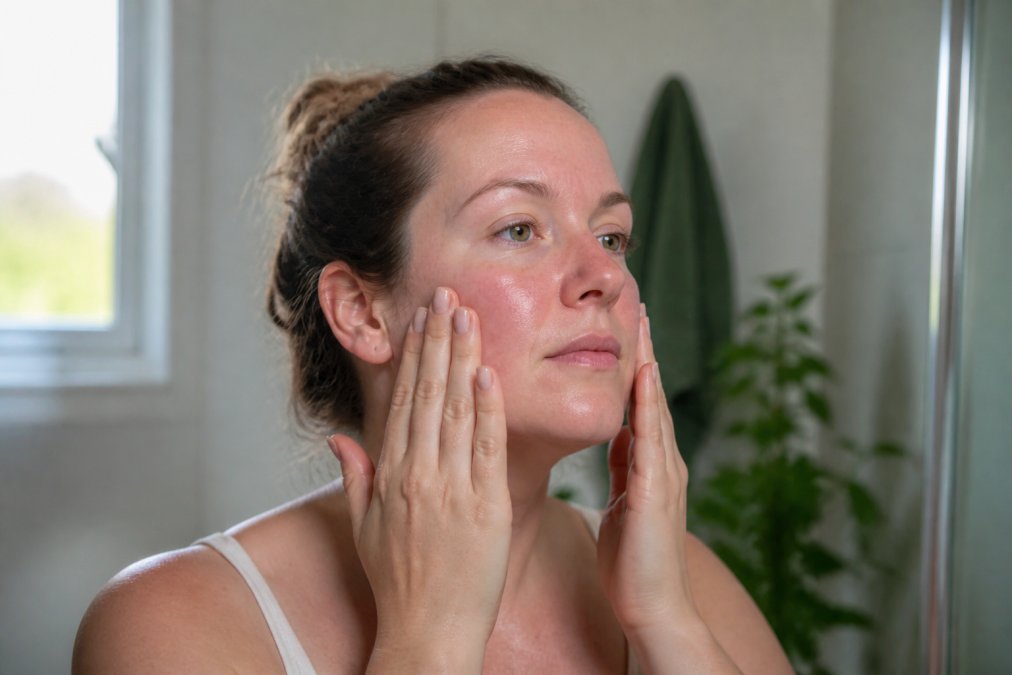
Application technique is about avoiding the physical triggers that cause vasodilation and flushing. Here is a protocol refined from dermatological nursing practice for lipid-rich formulations on reactive skin.
-
Cleanse with a non-foaming, lipid-free cleanser for no more than 30 seconds. Foaming cleansers disrupt the acid mantle. Use lukewarm water (32-35°C), hot water above 40°C triggers TRPV1 receptors and causes neurogenic inflammation.
-
Wait 60 seconds after cleansing before applying anything. The skin's pH takes up to 60 seconds to return to its natural 4.5-5.5 level after contact with water. Applying an oil-based product immediately can trap the elevated pH, slowing barrier enzyme activity.
-
Apply to skin that is damp but not wet. Olive oil is occlusive. Applying it to soaking-wet skin traps excess water, causing maceration and microbial overgrowth. The ideal state is skin patted dry with a soft cotton towel, then lightly misted with a thermal water spray containing selenium.
-
Use the 'three-point press' method, not circular rubbing. Circular motions create friction that can trigger a neurogenic flare. Dispense 2-3 drops onto your ring finger, dot onto each cheekbone and the centre of the forehead, then press with a flat palm for 10 seconds per area. The palms should be cool, heat transfers to facial capillaries and can induce flushing.
-
Layer a humectant serum under the olive oil moisturiser, not over it. Hyaluronic acid and glycerin need to pull moisture from the dermis. If applied over an occlusive layer, they cannot access water and will draw it from deeper skin layers. The correct order is: hydrating serum → olive oil moisturiser → (optional) thin layer of squalane oil.
-
Apply sunscreen 15 minutes after the moisturiser, not immediately. Applying sunscreen (especially mineral-based zinc oxide) immediately can cause pilling and uneven coverage. Zinc oxide is an astringent that can bind to free fatty acids, reducing barrier function.
-
Do not apply olive oil moisturiser to actively weeping or pustular skin. The occlusive nature can trap bacteria. Use a lightweight gel moisturiser with niacinamide during active flares, then reintroduce the olive oil formulation once pustules have resolved.
Cold-Pressed vs. Refined Olive Oil: Why It Matters
Refined olive oil undergoes heat and chemical processing that strips away the polyphenols responsible for anti-inflammatory benefits. Cold-pressed olive oil retains oleocanthal, squalene, and vitamin E, the compounds that support skin repair and antioxidant protection.
The 2026 PMC study demonstrating barrier improvement used extra virgin olive oil, the cold-pressed grade. Products made with refined olive oil may moisturize, but they lack the active constituents that make olive oil uniquely suited to inflamed skin. Look for "extra virgin" or "cold-pressed" as the source ingredient.
| Factor | Cold-Pressed | Refined |
|---|---|---|
| Polyphenol content | High | Stripped during processing |
| Anti-inflammatory activity | Present (oleocanthal) | Minimal |
| Skin barrier support | Clinically documented | Basic emollient only |
| Best for rosacea | Yes | Not recommended |
Conclusion: Building a Calming Routine
Managing rosacea requires a shift from reactive treatment to proactive barrier maintenance. An olive oil based moisturizer for rosacea offers a science-backed foundation, provided you choose a cold-pressed formulation free from irritants and apply it consistently. Oliveoil Skincare Group offers a range of cruelty-free, vegan formulations built on Australian-grown olive oil, designed to maintain hydration, improve skin flexibility, and support the anti-ageing process without triggering sensitivity. Shop Now and give your skin barrier the consistent, calming care it needs.
Frequently Asked Questions
Is olive oil good for rosacea skin?
Yes, when used correctly. Extra virgin olive oil contains oleocanthal, a natural anti-inflammatory compound, and oleic acid (55% to 83% of its composition) which supports the skin barrier. A 2026 study found it significantly improved barrier function by increasing skin capacitance and reducing redness. However, always patch test first and choose a cold-pressed, high-quality product like those from Oliveoil Skincare Group, as some oils can irritate highly reactive skin.
Is olive oil comedogenic? Will it clog my pores?
Olive oil has a comedogenic rating of 2 on a scale of 0 to 5, meaning it has a low to moderate chance of clogging pores. For most people with rosacea, this is not a problem, especially when the oil is formulated into a moisturizer with other non-comedogenic ingredients. The risk of irritation from synthetic additives usually outweighs the low pore-clogging risk of pure olive oil.
What ingredients should be avoided in moisturizers for rosacea?
Avoid moisturizers containing fragrance, essential oils like sage or lavender, alcohol, menthol, and harsh exfoliants like glycolic acid. These are documented rosacea irritants. A 2026 study found that frequently changing moisturizer brands increases rosacea risk (odds ratio 1.52), so once you find a gentle formula with calming botanical extracts and ceramides, stick with it for at least six weeks to see results.
How long does it take to see results with a natural moisturizer for rosacea?
Most dermatologists recommend committing to a new skincare routine for at least six to eight weeks before judging its effectiveness. In a 12-week clinical trial, a botanical moisturizer containing oat kernel oil and aloe vera outperformed metronidazole for reducing redness. For olive oil-based products, you may notice reduced stinging within days, but barrier repair and reduced redness typically take two to four weeks of consistent use.
