




Table of Contents
- Understanding Rosacea-Prone and Sensitive Skin
- Why Vegan Skincare Can Work for Rosacea (When Chosen Correctly)
- Ingredients to Avoid for Rosacea and What to Look For Instead
- How to Patch Test Skincare Before Committing to a Full Routine
- Building a Morning and Evening Skincare Routine for Sensitive Skin
- Choosing a Moisturiser for Rosacea-Prone Skin
- Troubleshooting Flare-Ups and Reintroducing Products Safely
- Frequently Asked Questions
Last Updated: October 7, 2026
Understanding Rosacea-Prone and Sensitive Skin
Rosacea-prone skin is characterised by chronic facial redness, visible blood vessels, and flushing. Its compromised barrier makes it more susceptible to environmental triggers and irritating ingredients.
Sensitivity is a weakened barrier that can't regulate inflammation. This is why generic "natural" products often fail: they may be free of synthetic chemicals but still contain botanical irritants that trigger the inflammation you're trying to prevent.
A product labelled natural or vegan isn't automatically gentle for reactive skin. Many plant extracts, essential oils, and botanical preservatives can provoke flare-ups.
According to research on skincare approaches in rosacea management from the Journal of Drugs in Dermatology, prescription medicines combined with gentle cleansers, moisturisers and sunscreen support rosacea therapy. This foundation is where vegan skincare enters the picture, not as a replacement for medical treatment, but as a complementary layer that respects your skin's fragility.

Why Vegan Skincare Can Work for Rosacea (When Chosen Correctly)
The challenge with vegan skincare for rosacea-prone skin isn't the absence of animal-derived ingredients, it's the plant-based alternatives that may irritate: botanical extracts, essential oils, or plant-based preservatives.
That said, vegan skincare absolutely can work. The key is knowing which plant ingredients calm inflammation and which provoke it. Olive oil, for instance, is vegan and well-tolerated by most rosacea-prone skin types, containing squalene and polyphenols that support barrier repair without triggering inflammation.
The mistake most people make is conflating "natural" with "gentle." A vegan product with lavender essential oil, rosemary extract, or citrus peel might be natural and cruelty-free but trigger redness within minutes. Conversely, a minimalist vegan formula with olive oil, ceramides, and panthenol can be exactly what reactive skin needs.
A clinical trial published in the Journal of Clinical and Aesthetic Dermatology evaluated a serum containing plant adaptogens in people with mild-to-moderate persistent centrofacial erythema associated with rosacea. The research demonstrates that certain botanical ingredients can support skin health when formulated thoughtfully.
Ingredients to Avoid for Rosacea and What to Look For Instead
Building safe vegan skincare for rosacea-prone skin starts with knowing what to exclude. Notorious triggers include alcohol (especially denat alcohol), menthol, camphor, fragrance (synthetic and essential oils), and high concentrations of botanical extracts like witch hazel or tea tree oil.
Fragrance deserves special attention. Many assume "natural fragrance" from essential oils is gentler than synthetic fragrance. It isn't. Peppermint oil, lemongrass, eucalyptus, and citrus oils are potent irritants for rosacea-prone skin, regardless of origin.
What you should look for instead:
- Ceramides: These lipid molecules repair the skin barrier without triggering inflammation. They're vegan-friendly when derived from plant sources.
- Panthenol (provitamin B5): A humectant that draws moisture into the skin and supports barrier function. Universally well-tolerated.
- Olive oil and other stable plant oils: Rich in antioxidants and barrier-supporting compounds. Olive oil specifically is hypoallergenic and rarely causes reactions.
- Aloe vera: Soothing and hydrating without the irritation profile of more astringent botanicals.
- Niacinamide (vitamin B3): Reduces redness and strengthens the barrier. Vegan and highly effective for reactive skin.
Avoid products listing essential oils in the first five ingredients. Avoid anything with alcohol listed as the second or third ingredient. Look for fragrance-free formulations, and verify this means no fragrance compounds at all, not simply "unscented with natural fragrance."
How to Patch Test Skincare Before Committing to a Full Routine
Patch testing is the only reliable way to know whether a product will work for your skin. Even the most carefully formulated vegan skincare can trigger reactions. The process takes five to seven days but saves weeks of inflammation.
Here's the method:
- Choose a discreet test area: The inner forearm is ideal, sensitive enough to predict facial reactions but hidden if irritation occurs. Behind the ear also works.
- Apply a small amount: Use roughly the size of a rice grain.
- Leave it for 24 hours: Resist washing it off or applying other products to that spot.
- Observe for 48 hours after application: Watch for redness, stinging, itching, or any sign of irritation. Rosacea-prone skin can react with a delay.
- If no reaction occurs, apply to the face: Start with a small amount on one cheek, once daily for three days before full incorporation.
- Monitor for one week: Even if the initial patch test passes, continue observing. Some reactions emerge gradually.
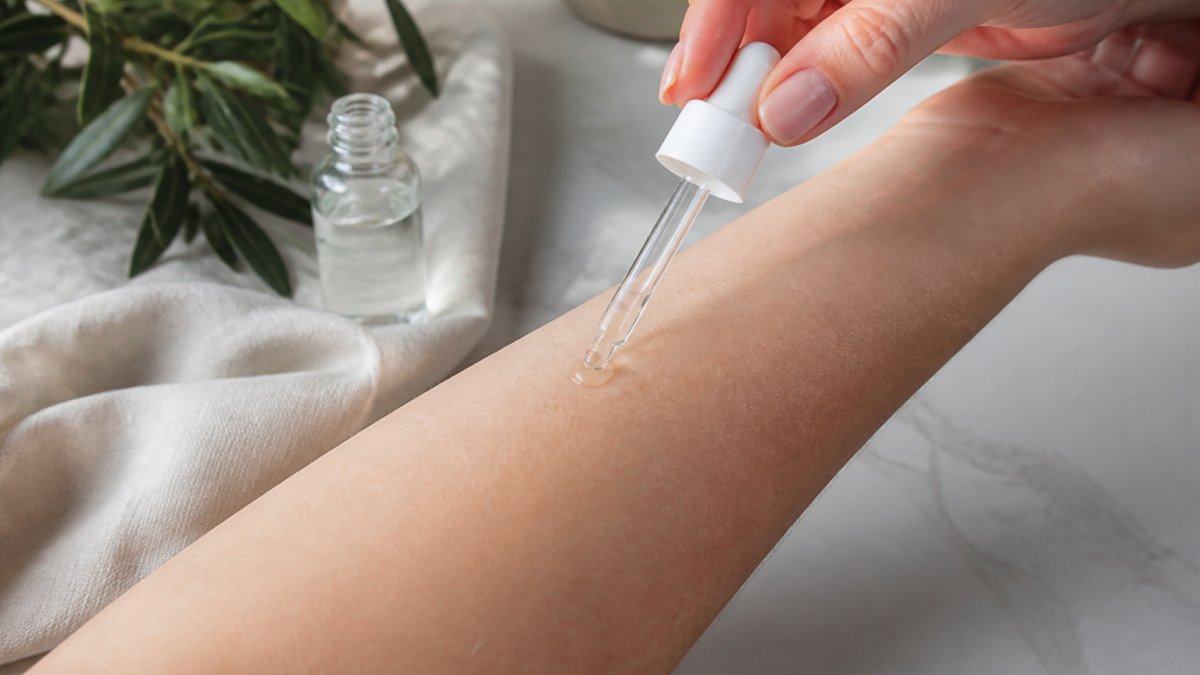
The temptation to skip this step is strong, especially when you're desperate for a product that works. Don't. A week of patience prevents weeks of flare-ups.
Building a Morning and Evening Skincare Routine for Sensitive Skin
A functioning routine for rosacea-prone skin follows a clear sequence: cleanse, treat, moisturise, protect. Rosacea-prone skin tolerates fewer steps, not more, so the goal is a routine you can repeat twice daily without triggering flushing.
Morning routine:
- Cleanse (30 seconds): Use a fragrance-free, sulfate-free cleanser with lukewarm water. Hot water dilates facial blood vessels and can provoke flushing. Pat dry, do not rub.
- Moisturise (1-2 minutes): Apply while skin is still slightly damp. Choose an olive-oil-based or ceramide-rich formula.
- Sunscreen (2-3 minutes): Non-negotiable. UV exposure is one of the most commonly reported rosacea triggers. Choose a broad-spectrum, fragrance-free formula with SPF 30 or higher. Mineral filters (zinc oxide, titanium dioxide) are often better tolerated by reactive skin, though some find them drying; chemical filters can sting on compromised barriers. The right choice is the one your skin accepts and you will actually wear daily.
Evening routine:
- Cleanse (30 seconds): Same as morning. If you wore sunscreen, a single gentle cleanse is usually enough; avoid double-cleansing unless your skin tolerates it.
- Treatment serum (optional, 1-2 minutes): Apply here, then wait 60 seconds before moisturising.
- Moisturise (1-2 minutes): Same approach as morning, applied to damp skin.
| Step | Product Type | Timing | Notes |
|---|---|---|---|
| Cleanse | Fragrance-free, sulfate-free | 30 seconds | Use lukewarm water, pat dry gently |
| Treat | Calming serum (optional) | 1-2 minutes | Wait 60 seconds before next step |
| Moisturise | Ceramide or olive-oil-based | 1-2 minutes | Apply to damp skin for better absorption |
| Protect (AM only) | Broad-spectrum SPF 30+ | 2-3 minutes | Fragrance-free; mineral or chemical depending on tolerance |
The routine should take under 10 minutes total. If it is more complicated, you will skip steps during busy mornings, and inconsistency worsens rosacea.
Introducing actives cautiously
Olive Oil Soap, All-Natural, Unscented, 100g →
If you want to add an evidence-aware active such as azelaic acid or niacinamide, introduce it slowly. Azelaic acid is used in rosacea care for redness and papules, but it can sting on a compromised barrier. Niacinamide is generally better tolerated, but higher concentrations can still irritate.
Choosing a Moisturiser for Rosacea-Prone Skin
A moisturiser for rosacea-prone skin must hydrate, repair the barrier, and calm inflammation. It should feel lightweight, since heavy occlusive creams can trap heat and trigger flushing, absorb quickly without a greasy residue, and be fragrance-free.
Olive-oil-based moisturisers excel here. Olive oil absorbs efficiently rather than sitting on the surface, and contains natural squalene and polyphenols that support barrier integrity.
The Serenity Face Moisturiser from Oliveoil Skincare Group (available in 40ml for £15.99 or 125ml for £39.99) exemplifies this approach. Formulated with Australian-grown olive oil, vitamins B and E, and olive leaf extract, it's designed to strengthen the skin barrier while remaining hypoallergenic.

When selecting any moisturiser, look for hypoallergenic certification, fragrance-free labelling, and a short ingredient list (under 15 ingredients is ideal). Avoid alcohol, silicones, or heavy fragrance notes. If it leaves your skin tight or causes stinging, discontinue use immediately.
Troubleshooting Flare-Ups and Reintroducing Products Safely
Even with careful product selection, flare-ups happen. The goal is not to eliminate them entirely, but to minimise their frequency and severity, then recover quickly. The first step is working out what you are dealing with.
Distinguishing irritation from a rosacea flare
Skincare irritation and a rosacea flare can look similar, but they behave differently.
This is a cautious guide, not a diagnosis. If you have severe pain, swelling, blistering, eye involvement such as redness, burning, or a gritty sensation, or symptoms worsening despite simplifying your routine, seek medical care.
The reset protocol
When a flare-up occurs, step back immediately. Stop any new or optional products, including serums, exfoliants, and masks. Return to your proven baseline routine: gentle fragrance-free cleanser, a simple moisturiser, and sunscreen.
Reintroducing products one at a time
Once calm returns, reintroduce products one at a time, waiting a full week between additions. This isolates which product triggered the reaction. A practical schedule:
- Days 1-7: Baseline routine only. Confirm skin is calm and stable.
- Days 8-14: Add one product back, applied to a small area first, then the full face if tolerated.
- Days 15-21: If no reaction, add the next product. If a reaction occurs, stop the most recently added product and return to baseline before trying again.
- Ongoing: Keep a simple note of what you added and when, so patterns are easier to spot.
If a product consistently triggers flare-ups, accept that it is not compatible with your skin, regardless of how natural or vegan it is. Skin compatibility is individual.
For persistent flare-ups despite careful product selection, consult a dermatologist or general practitioner. Rosacea-prone skin sometimes needs prescription support alongside skincare. Skincare products support treatment; they do not replace it.
Frequently Asked Questions
How do I know if a vegan skincare product is actually suitable for rosacea-prone skin?
Vegan labelling alone doesn't guarantee suitability for rosacea. Check the ingredient list for known triggers like fragrance, essential oils, and alcohol. Look for products that explicitly mention they're fragrance-free and free from essential oils. Research published in the Journal of Drugs in Dermatology emphasises that gentle cleansers, moisturisers, and sun protection support rosacea therapy. Always patch test first, even if a product is vegan and natural, because individual sensitivity varies.
What's the best way to patch test skincare if I have rosacea?
Apply a small amount of the new product to a discrete area like your inner forearm or behind your ear. Wait 24-48 hours and observe for redness, stinging, or burning. If no reaction occurs, apply it to a small facial area (like your jawline) for another 2-3 days before incorporating it into your full routine. This gradual approach helps you identify irritants without triggering a widespread flare-up. Discontinue use immediately if any irritation appears.
How long should I wait before seeing results from a new vegan skincare routine?
Most people need 4-6 weeks of consistent use to assess whether a product is working for their rosacea-prone skin. Your skin barrier repair and inflammation reduction don't happen overnight. However, if you experience stinging, burning, or increased redness within the first week, the product may not be right for you. Keep a simple log of how your skin feels each week to track progress objectively.
What ingredients should I look for in a moisturiser for rosacea-prone skin?
Seek moisturisers containing calming ingredients like panthenol, ceramides, and aloe vera, which support skin barrier repair. Olive oil is particularly beneficial because it contains vitamins A, E, and K, plus naturally occurring squalene and polyphenols that strengthen your skin's natural barrier. Avoid heavy occlusive ingredients if they trigger your rosacea. A lightweight, oil-based moisturiser that absorbs quickly (rather than sitting on top of your skin) works best for most rosacea-prone skin types.
