



Last Updated: November 7, 2026
Quick Summary
To choose baby skincare products safely, start with a short, gentle routine: a mild cleanser, a plain moisturiser and a barrier cream for the nappy area. Check the ingredient list for fragrance, harsh cleansers and unnecessary additives, and patch test new products on a small area for 24 to 48 hours before wider use.
- Plain water and a soft cloth are enough for most newborn cleaning in the first six weeks.
- Ingredients are listed by concentration, so the first five tell you most of what a product is.
- Apply a fragrance-free moisturiser within three minutes of a bath, while skin is still damp.
- Zinc oxide and petrolatum are the two best-evidenced barrier cream ingredients.
- Stop using any product that causes redness, stinging or a new rash within 24 to 48 hours.
Table of Contents
- Start With the Basics: What Baby Skin Actually Needs
- Newborn Skincare Essentials: What You Really Need
- How to Read Baby Skincare Labels Without Guessing
- Baby Skincare Ingredients to Avoid
- Baby Skincare for Sensitive Skin: Matching Products to Skin Concerns
- How to Patch Test and Introduce a New Product
- Shop Gentle, Unscented Options for Your Baby's Routine
- Frequently Asked Questions
Start With the Basics: What Baby Skin Actually Needs
According to Future Market Insights' baby skincare market analysis, the global baby skincare market is projected to grow at 6.1% a year through 2036. That growth tells you something: parents are buying more products than ever.
Baby skin is thinner and loses moisture faster than adult skin. Its barrier is still developing. That makes it more prone to dryness and irritation.
So the core needs are simple:
- Gentle cleansing without stripping natural oils
- Steady moisture to support the skin barrier
- Protection from irritants, especially fragrance
At Oliveoil Skincare Group, we keep coming back to one idea: a short, gentle routine beats a crowded shelf. The Royal Children's Hospital Melbourne's skincare guidance backs this up, recommending products free from fragrance, botanicals and antibacterial agents because these can irritate delicate skin.
That's your baseline. Everything else is detail.
Newborn Skincare Essentials: What You Really Need
Newborn skincare essentials come down to three things: a mild cleanser, a plain moisturiser, and a barrier cream for the nappy area. That's it. Most newborns do not need lotions, oils, powders or scented washes.
Plain water is often enough for the first few weeks. Keep baths short and lukewarm.
A common mistake is buying a full "baby set" before you know what your baby's skin tolerates. Start minimal and add products only when a real need appears.
Watch out: heavily fragranced "baby" products are still common on shelves. A cute label does not make a product gentle. Check the ingredient list first, every time.
How to Read Baby Skincare Labels Without Guessing
Reading a baby skincare label means scanning the ingredient list for three things: fragrance, harsh cleansers, and unnecessary additives. The shorter the list, the easier it is to judge. But the ingredient list is only half the story, the front of the pack is marketing, and the back is where the real information sits.
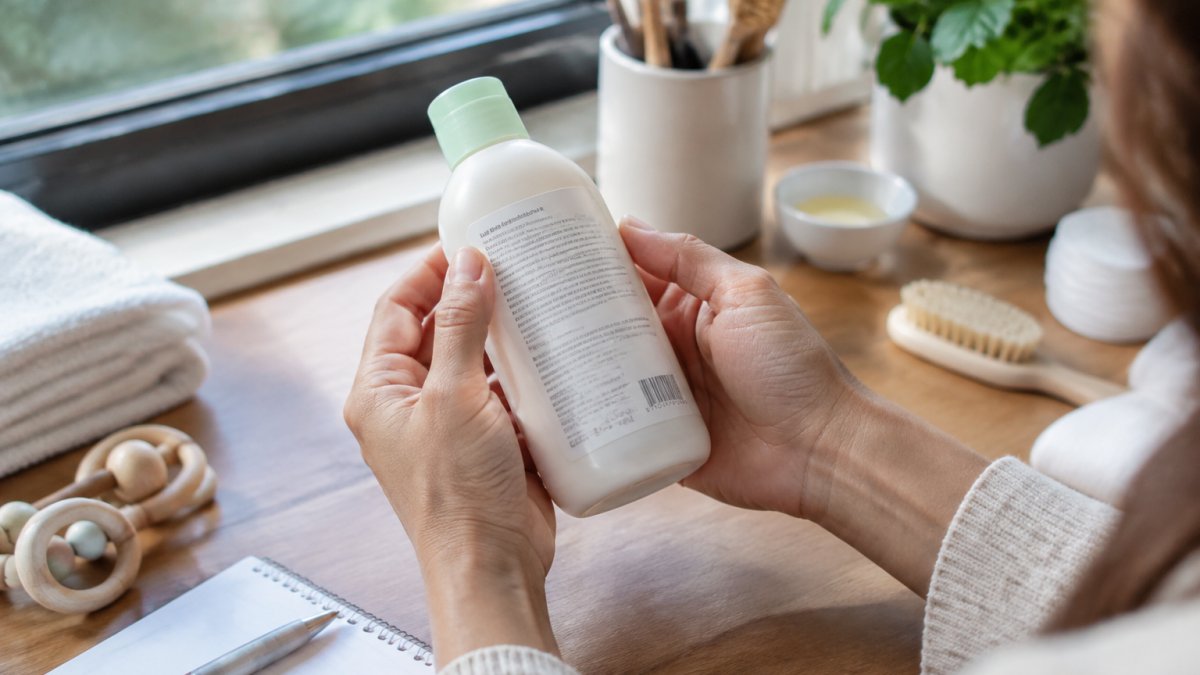
Here's a practical checklist we'd use in the aisle:
- No "fragrance" or "parfum" listed
- No essential oils or botanical extracts
- No sodium lauryl sulphate (SLS)
- No parabens or phthalates
- Fewer than 10 ingredients, where possible
- Clear "patch test before use" guidance on the pack
Decode the ingredient list in order
Ingredients are generally listed by concentration, from highest to lowest. That means the first five ingredients tell you most of what the product is. If water, glycerin, and a plain emollient lead the list, you're looking at a simple moisturiser.
Watch out: "fragrance" and "parfum" are catch-all terms that can hide dozens of individual compounds, and a product labelled "fragrance-free" may still contain masking fragrance to cover the smell of raw ingredients.
What the marketing terms actually mean
- Hypoallergenic: a term manufacturers use to suggest a product is less likely to cause allergy. It is not a guarantee and does not mean fragrance-free.
- Dermatologist-tested: the product was tested on skin under dermatological supervision. It says nothing about which ingredients were used or how many people reacted.
- Natural: refers to ingredient origin, not safety. Essential oils and botanical extracts are natural and are among the most common causes of irritation in babies.
- Suitable from birth: a manufacturer's claim, not a regulatory approval. Check the ingredient list rather than relying on the age statement.
- Soap-free: usually means synthetic detergents (syndets) replace soap. Gentler than soap, but still check for SLS and fragrance.
- Tear-free: relates to pH and surfactant choice, not to whether the product is fragrance-free or suitable for eczema-prone skin.
Preservatives: not all are equal
Preservatives are necessary in any water-based product to stop mould and bacteria growing. The concern is with specific types, not the category. Parabens and phthalates are the ones most commonly flagged; phenoxyethanol and sodium benzoate are widely used alternatives. A product with no preservative at all is only plausible if it is anhydrous (oil- or balm-based) or single-use.
Check the batch and expiry
Baby products do not last forever. Look for a batch number and either a best-before date or a period-after-opening symbol (the small jar icon with a number of months). Check the period-after-opening symbol on the pack, as shelf life varies by product.
Labels like "hypoallergenic" and "dermatologically tested" are useful signals, but they are not guarantees. Treat them as a starting point, then check the actual ingredients.
Baby Skincare Ingredients to Avoid
Certain baby skincare ingredients to avoid show up again and again in reactions. Fragrance sits at the top of the list. So do antibacterial agents, which the Royal Children's Hospital Melbourne advises against for infant skin.
The main ones to skip:
- Synthetic fragrance and parfum
- Essential oils and strong botanical extracts
- Sodium lauryl sulphate and other harsh foaming agents
- Parabens and phthalates
- Antibacterial additives
A review of market trends in baby skincare products found product use was widespread across age groups, with prevalence above 50%, and noted this may conflict with recommended skincare guidance. In short: more product is not better.
Baby Skincare for Sensitive Skin: Matching Products to Skin Concerns
Baby skincare for sensitive skin should match the product to the concern, not the other way around. Dry patches need a plain emollient. Nappy rash needs a barrier cream. Eczema needs fragrance-free care and, often, a clinician's input.
For reactive or eczema-prone skin, our gentle skincare for babies with eczema guide walks through a step-by-step routine. If you want a fuller overview of gentle baby skincare for sensitive skin, that guide covers matching products to reactive skin in more depth.
Match the product to the age and situation
- Newborn (0-6 weeks): plain water and a soft cloth for most cleaning. No lotions, oils, or washes unless a clinician advises otherwise. The skin barrier is still forming and is easily overwhelmed.
- Older baby (6 weeks-12 months): a soap-free wash two to three times a week, a plain fragrance-free moisturiser for dry patches, and a barrier cream at every nappy change.
- Dry skin: a fragrance-free moisturiser or balm applied within three minutes of a bath, while the skin is still slightly damp, to lock in water.
- Nappy area: a plain barrier cream applied at each change, with time uncovered to air helping the skin.
- Eczema-prone skin: fragrance-free wash and moisturiser and short lukewarm baths, with a clinician's guidance where needed.
- Normal skin: mild cleanser and occasional moisturiser. Most babies need nothing more.
What each product type actually does
- Cleansers remove oil and dirt. Soap-free syndets are generally gentler than traditional soap.
- Moisturisers fall into three groups: lotions (water-based, lightest), creams (oil-and-water emulsions), and ointments or balms (oil-based, most occlusive). For very dry or eczema-prone skin, a cream or balm holds moisture better than a lotion.
- Barrier creams form a physical layer between skin and nappy contents. Zinc oxide and petrolatum are the two most common and best-evidenced ingredients.
- Oils are not moisturisers on their own, they seal in moisture but do not add water. Apply after a bath, not instead of a moisturiser.
When to stop and when to escalate
A common pattern is that a product causes redness, stinging, or a new rash within 24 to 48 hours of first use.
Seek a clinician's assessment if:
- A rash spreads, weeps, crusts, or looks infected
- Irritation persists beyond a few days after stopping the product
- Your baby seems uncomfortable, is not sleeping, or is distressed by the skin
- You suspect an allergy (hives, swelling, or a reaction beyond the application site)
- Eczema flares are frequent or not controlled by fragrance-free care
- The nappy area does not improve with barrier cream, or develops blisters or ulcers
Watch out: a product marketed as "suitable for eczema" is not a treatment. Eczema management often needs a clinician-guided plan, and delaying that assessment can make flares harder to control.
Less is more here.
Match the product to the concern and the baby's age, not the other way around.
| Situation | What to use | Note |
|---|---|---|
| Newborn (0-6 weeks) | Plain water and a soft cloth | No lotions, oils or washes unless a clinician advises |
| Older baby (6 weeks-12 months) | Soap-free wash two to three times a week | Plus fragrance-free moisturiser and barrier cream |
| Dry skin | Fragrance-free moisturiser or balm | Apply within three minutes of a bath, skin still damp |
| Nappy area | Plain barrier cream at each change | Zinc oxide and petrolatum are best-evidenced ingredients |
| Eczema-prone skin | Fragrance-free wash and moisturiser, short lukewarm baths | Clinician's guidance where needed |
| Normal skin | Mild cleanser and occasional moisturiser | Most babies need nothing more |
How to Patch Test and Introduce a New Product
A patch test means applying a small amount of a new product to a small area of skin and watching for a reaction before using it more widely.
Here's how we'd do it:
- Apply a pea-sized amount to one small spot
- Wait 24 to 48 hours
- Check for redness, swelling or itching
- If clear, try a slightly larger area
- Stop immediately if any reaction appears
Before you start, it helps to understand why natural skincare can cause stinging, since "natural" does not automatically mean gentle. If a reaction occurs, stop using the product and speak to a clinician if it persists.
Shop Gentle, Unscented Options for Your Baby's Routine
When you're ready to buy, unscented and simple wins. The all-natural unscented olive oil soap is free from SLS, palm oil and parabens, and is suitable for all ages and skin types. For dry patches, the Soothing Balm Pure Original is a plain, unscented balm with no colouring agents or additives.


Both are Australian made and vegan. Neither relies on fragrance to do the work.
Choosing baby skincare products can feel overwhelming, but the rules are simple: fewer ingredients, no fragrance, and a patch test before anything new. At Oliveoil Skincare Group, we make all-natural, Australian-made products with olive oil, free from SLS, palm oil, parabens and artificial colourings.
Frequently Asked Questions
What skincare products does a newborn actually need?
Most newborns need very little. A mild, fragrance-free cleanser, a plain moisturiser for dry patches and a barrier cream for the nappy area cover the basics. The Royal Children's Hospital recommends products without fragrance, botanicals or antibacterial agents because these can irritate delicate skin. Bath water alone is often enough for the first few weeks, so add products only when there is a clear need such as dryness or nappy rash. A minimal routine makes it easier to spot which product caused a reaction if one appears.
Which ingredients should I avoid in baby skincare products?
Check labels for fragrance, botanical extracts, essential oils and antibacterial agents, which the Royal Children's Hospital lists as common irritants for baby skin. Also look for sodium lauryl sulphates, parabens, phthalates and artificial colourants. Fewer ingredients generally means fewer chances of irritation, so favour short, simple lists.
Are natural baby skincare products always safer?
Not automatically. Natural-origin ingredients such as botanical extracts and essential oils can still trigger irritation or an allergic reaction on delicate skin. What matters is the full ingredient list, not the marketing claim on the front of the pack. Choose products with simple ingredients, no added fragrance and a clear statement of what is excluded, such as SLS, parabens and artificial colourants. Patch test any new product, natural or otherwise, before using it widely.
Should I patch test a new baby skincare product?
Yes. Apply a small amount to a small area of skin, such as the inner forearm, and wait 24 to 48 hours before using it more widely. Watch for redness, dryness or a skin reaction, and stop using the product if irritation appears. Patch testing is especially important for baby skincare for sensitive skin, where a reaction is more likely. Introduce one new product at a time so you can tell which one caused a problem if one occurs.

